
Choosing Between Acoustic and Vibration Monitoring
Updated
Choose signals for rotating-equipment monitoring according to the expected change, its location, and the maintenance decision it supports. Neither acoustic nor vibration monitoring is always more accurate.
A microphone receives airborne sound, while a vibration sensor measures motion at its mounting point. Acoustic emission concerns signals generated inside a material and carried through the structure. Failing to distinguish the three measurements leads to installation and interpretation errors.

An illustrative image of rotating equipment.
Signals by observation purpose
| Question | Signal to consider first | Context to record |
|---|---|---|
| Has a new sound appeared around the machine? | Airborne acoustic data | Background noise, microphone position, operating state |
| Has motion changed at a structural point? | Vibration | Mounting point, direction, speed and load context |
| Is the task focused on transient events within a material or structure? | Acoustic emission | Transmission path, sensor coupling, analysis purpose |
After choosing an observation point, confirm faults by reviewing equipment structure, operating context, maintenance history, and field findings.
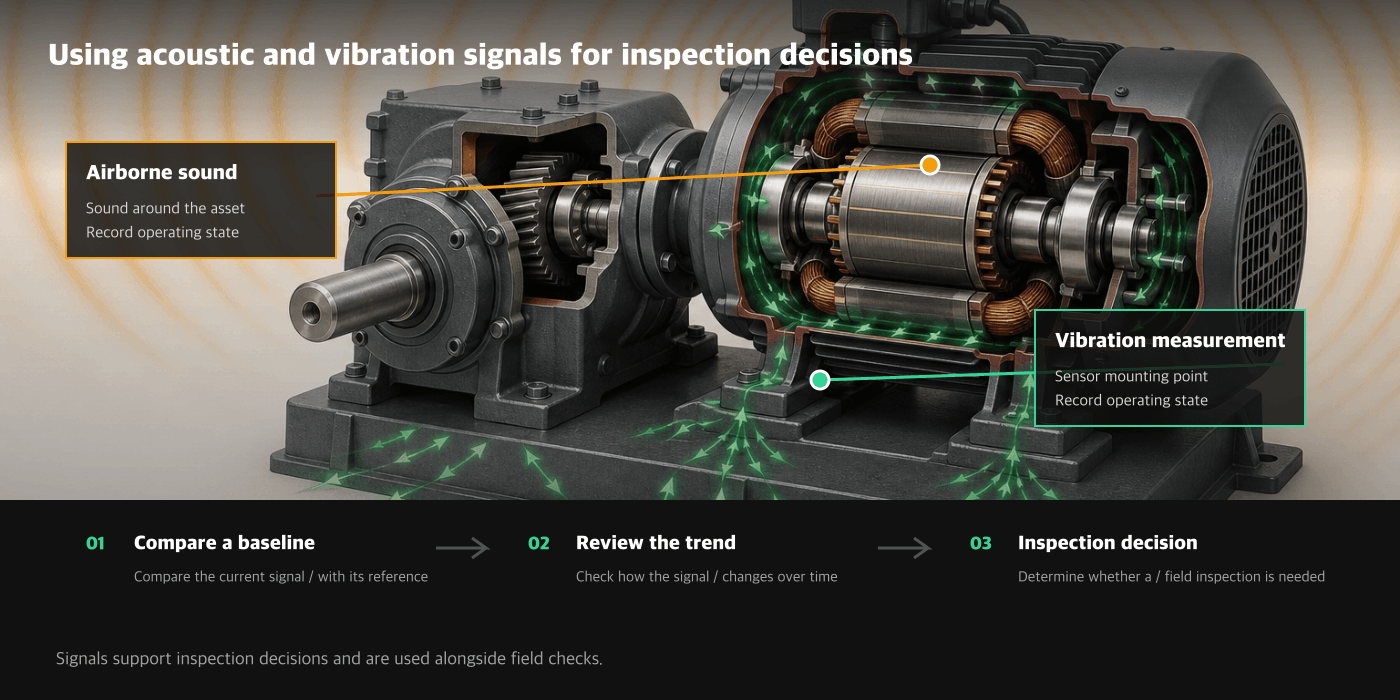
Figure 1. Select the observation point, compare a baseline and trend, then send the finding into a field inspection.
Microphone and accelerometer measurement conditions
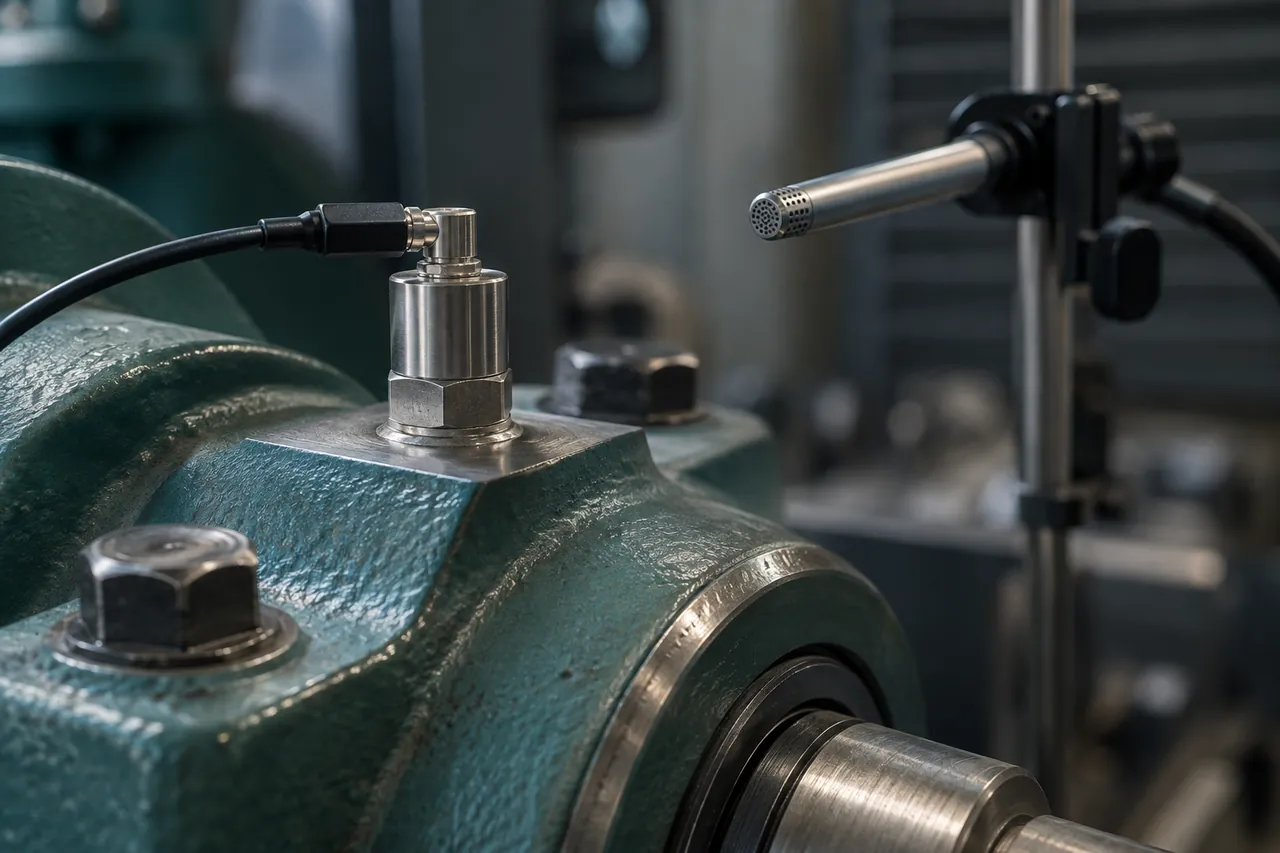
An illustrative image of vibration sensor and microphone placement. It does not represent a specific product.
Airborne acoustics can detect changes where mounting a sensor is impractical. Nearby equipment and work noise are also captured, so microphone position and collection context must stay consistent. Detecting an unfamiliar sound and identifying its cause remain separate tasks.
Vibration measurements depend on the mounting point. A bearing housing and a frame on the same asset can produce different signals. Record the location, direction, and operating state with the data to support comparison.
Acoustic emission and airborne sound
Acoustic monitoring and acoustic emission are sometimes used interchangeably, but they measure different signals. Acoustic emission measures structure-borne signals from events inside a material; its sensors, coupling, and analysis purpose differ from those of a microphone recording airborne sound.
Specify the measurement method in the monitoring plan so the equipment and analysis match it. Do not apply acoustic-emission criteria to airborne sound or interpret acoustic-emission results as general noise measurements.
Trends only compare under matching conditions
ISO 20816-1 bases operational monitoring on vibration measured during normal operation. Record speed, load, process state, and sensor placement with the baseline because they affect the measured signals.
An outlier is a reason to inspect, not a finished diagnosis. Check the prior trend and the maintenance history, then verify the machine itself.
Before the sensor order goes out
Define the change to observe and the maintenance decision it would support before choosing a signal. Record sensor position and direction in a repeatable form, retain background noise and operating state with the baseline, and re-baseline after maintenance or sensor changes. Assign a purpose to each signal when using several together. Use anomalies as a reason to start an inspection.
For motors and gearboxes, Motor Sound Diagnostics shows how these signals can support field alerts. Define inspection questions and procedures before selecting a tool.